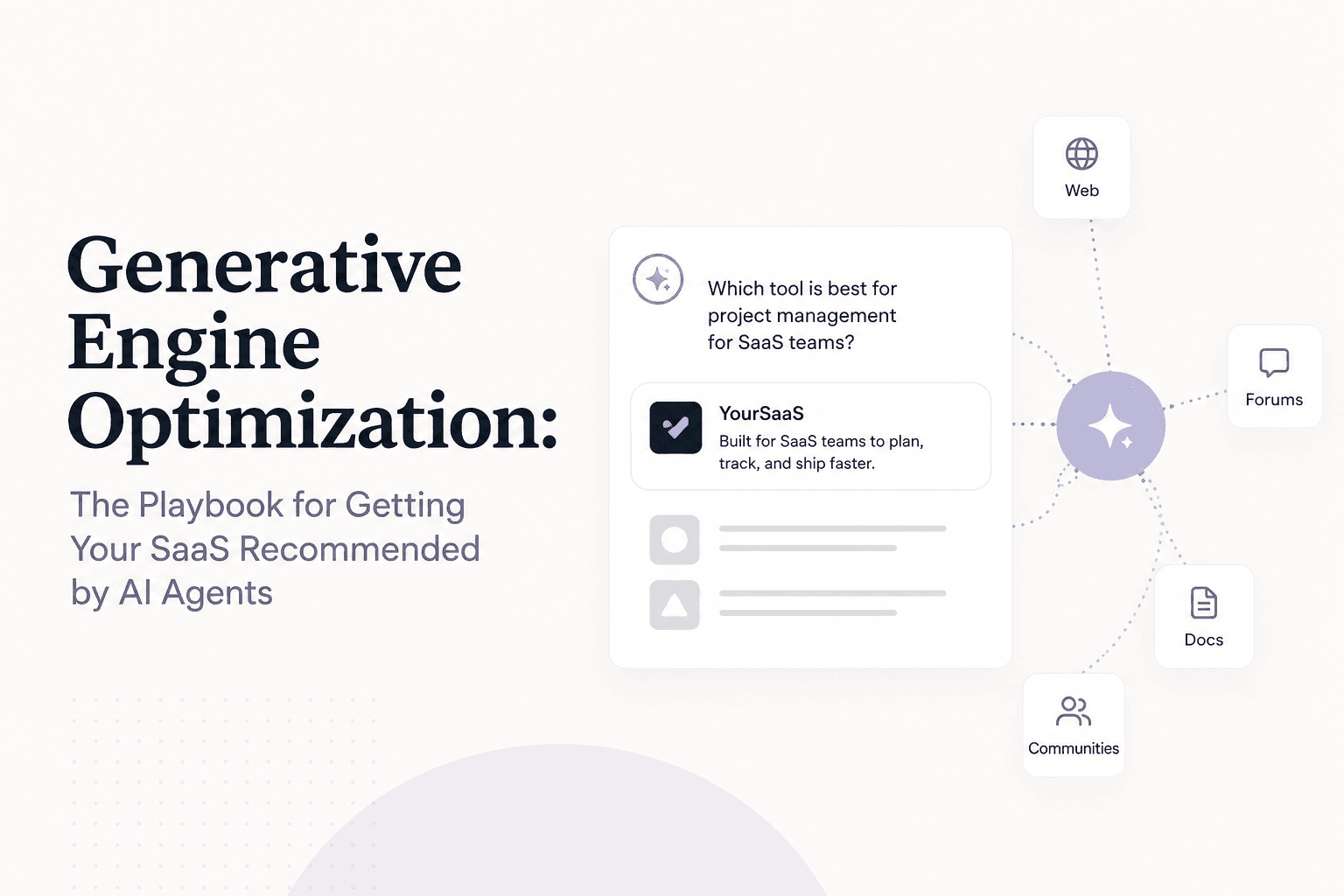
Generative Engine Optimization: The Playbook for Getting Your SaaS Recommended by AI Agents
Generative Engine Optimization (GEO) is the practice of optimizing your SaaS so AI systems like ChatGPT and Claude recommend your product to users.
There's a shift happening in how people find software, and most SaaS founders haven't fully reckoned with it yet.
Someone opens ChatGPT, Claude, or Perplexity and types: "What's the best tool for managing customer onboarding?" or "Which CRM should a 10-person B2B SaaS use?" The AI responds with a short list of recommendations — sometimes with reasoning, sometimes with links. The user picks one, clicks through, signs up for a trial.
No Google. No review site. No keyword-stuffed landing page. Just a conversation, a recommendation, and a conversion.
This is the new top of the funnel, and most companies are completely invisible in it.
Generative Engine Optimization (GEO) is the discipline of making your SaaS discoverable, understandable, and recommendable by AI systems. It's not a replacement for SEO. It's a parallel game with different rules — and right now, the field is wide open.
This article covers everything you need to know to play it.
What GEO Actually Is (And What It Isn't)
GEO is the practice of optimizing your web presence, content, and technical infrastructure so that large language models (LLMs) — and the AI-powered agents built on top of them — surface your product when users ask relevant questions.
The term was popularized in a 2023 paper from researchers at Princeton, Georgia Tech, Allen AI, and IIT Delhi, which demonstrated that certain content strategies significantly increased citation rates in AI-generated responses. But practitioners have since taken it much further.
The difference from SEO
In SEO, you're optimizing for a ranking algorithm. The goal is to appear at position one for a keyword. The algorithm is relatively transparent — crawlability, backlinks, page speed, topical authority.
In GEO, you're optimizing for a reasoning system. The goal is to be cited or recommended when an AI synthesizes an answer. The system is less transparent, but it's not a black box — it has identifiable preferences.
A few critical differences:
- SEO rewards keywords. GEO rewards concepts. If someone asks "what's the best tool for async team communication," the AI isn't matching keywords — it's reasoning about the question and retrieving tools that fit the concept.
- SEO rewards links pointing at you. GEO rewards mentions, citations, and discussions across the web — including in places Google deprioritizes, like forums, Reddit, newsletters, and documentation.
- SEO has clear metrics (rankings, impressions, clicks). GEO metrics are murkier — you're tracking things like AI citation share, brand mention volume, and how often your product appears in AI responses for target queries.
- SEO is page-level. GEO is entity-level. The AI builds a picture of what your product is, who it's for, and what problems it solves — from many sources, not just your homepage.
Why it matters now
LLM usage as a discovery mechanism is accelerating fast. Perplexity crossed 100 million monthly active users in early 2025. ChatGPT search rolled out to all users. AI assistants are embedded in browsers, productivity tools, and operating systems. Agentic systems are starting to autonomously select and interact with software tools on users' behalf.
The companies that get their GEO right now are building a compounding advantage — because AI models are trained on historical web data, and mentions accumulate over time.
How LLMs Actually Decide What to Recommend
Before you can optimize for something, you need to understand how it works.
LLMs recommend tools through a combination of:
1. Pre-training data
The foundational model was trained on a massive corpus of web text — articles, forums, documentation, GitHub repos, academic papers, Hacker News threads, Stack Overflow answers, product reviews. Everything it "knows" about your product comes from what was in that training data.
If your product was frequently mentioned in positive contexts in that corpus, the model has a prior disposition toward recommending you. If you're barely mentioned, you're invisible at the base level.
This is why established, frequently-discussed products have a structural advantage — and why younger products have to work harder on the dimensions that can be changed quickly (context-window-level signals, real-time retrieval, structured data).
2. Retrieval-Augmented Generation (RAG)
Many AI systems — including Perplexity, ChatGPT with search enabled, and most enterprise AI assistants — don't rely solely on training data. They retrieve current web content at query time and synthesize a response from it.
This is where GEO gets actionable fast. If your content is the best available resource on a given topic, it gets retrieved and cited. That means:
- Your content needs to be crawlable
- It needs to match the semantic intent of queries, not just keywords
- It needs to be structured clearly enough for the AI to extract and summarize
3. Tool/plugin directories and agent registries
As AI agents become more capable and autonomous, they increasingly select tools from structured registries — OpenAI's plugin store, agent frameworks like LangChain's tool hub, or enterprise AI platforms that let admins configure which SaaS products agents can interact with.
Getting listed in these registries, with clear capability descriptions and well-documented APIs, is a distinct GEO lever.
4. Inference from the web graph
LLMs and search-augmented AI systems also pick up on signals that mirror traditional authority signals: how often you're mentioned alongside credible sources, whether review platforms and comparison sites include you, whether authoritative newsletters and publications cover you.
The key distinction: a mention in a Substack newsletter with 20,000 subscribers can matter more for GEO than a link in a low-authority blog — because the AI is reasoning about context and credibility, not just counting backlinks.
The GEO Audit: Where You Stand Today
Before building a strategy, benchmark your current position. Here's how.
Step 1: Query your target AI systems directly
Pick 20–30 queries that represent your target customer's intent. Be realistic — don't just test branded queries.
Examples for a project management tool:
- "What's the best project management software for a remote engineering team?"
- "Alternatives to Jira for small teams"
- "How should a startup organize sprint planning?"
- "Tools for async project tracking"
Run these in:
- ChatGPT (with and without web search enabled)
- Claude
- Perplexity
- Gemini
- Your most relevant niche AI tool (e.g., an AI assistant in your industry)
Track: Are you mentioned? Where in the response? With what framing? What competitors appear instead?
Step 2: Check your web presence density
Search your brand name + category across:
- G2, Capterra, Trustpilot, Product Hunt
- Reddit (r/SaaS, r/entrepreneur, and niche subreddits for your category)
- Hacker News (use
hn.algolia.com) - Twitter/X and LinkedIn (mentions in professional contexts)
- Comparison blogs and "best tools for X" articles
- Developer forums if you have an API/technical product
- Your industry's newsletters and media outlets
A sparse presence here = sparse AI training signal.
Step 3: Check your technical crawlability
- Can AI crawlers access your site? Check
robots.txt— some sites accidentally block AI crawlers like GPTBot, ClaudeBot, PerplexityBot - Is your key content behind JavaScript rendering walls?
- Do you have a sitemap that's accurate and up to date?
- Is your documentation indexed and accessible?
Step 4: Assess your content's answer-fitness
Take your most important landing pages and documentation. Ask: if an AI retrieved this page to answer a user question, how useful would it actually be?
Signs of low answer-fitness:
- Heavy on marketing language, light on specifics
- Doesn't clearly articulate the use case
- No comparison to alternatives
- Assumes the reader already knows what the product does
The GEO Playbook: What to Actually Do
1. Define Your AI-Facing Entity
Think of your product as an entity that AI systems need to understand. The clearer and more consistent that entity is across the web, the more confidently the AI will surface you.
Your entity definition should include:
- What it is: A [category] tool that [primary function]
- Who it's for: [ICP], particularly [specific use case]
- What problems it solves: [3–5 specific pain points]
- How it's different: [2–3 genuine differentiators]
- What it integrates with: [key integrations that signal your category]
This isn't just brand messaging. It's the semantic fingerprint you need to establish across everything you publish.
Use this definition consistently in your homepage, About page, documentation, press materials, and any content you create. The AI builds its model of your product from multiple sources — consistency across them reinforces the signal.
2. Build the llms.txt File
This is one of the most concrete, underutilized GEO tactics available right now.
llms.txt is a proposed standard (similar to robots.txt or sitemap.xml) that provides AI systems with a structured, curated summary of your site — what it contains, what the key pages are, and how to understand your product.
The spec was proposed by Jeremy Howard (fast.ai) in late 2024 and has gained significant traction. Here's how to implement it:
Create /llms.txt at your root domain. The format is Markdown-based and intentionally simple:
# YourProduct

> One-sentence description of what your product is and does.

YourProduct is a [category] tool that helps [ICP] [primary benefit]. It [2-3 sentences of additional context that an AI would need to recommend you accurately].

## Key pages

- [Homepage](https://yourproduct.com): Overview of features and use cases
- [Pricing](https://yourproduct.com/pricing): Plans and pricing details
- [Documentation](https://docs.yourproduct.com): Full product documentation
- [API Reference](https://docs.yourproduct.com/api): API documentation for developers
- [Integrations](https://yourproduct.com/integrations): Supported integrations

## Use cases

- [Use case 1](https://yourproduct.com/use-cases/use-case-1)
- [Use case 2](https://yourproduct.com/use-cases/use-case-2)

## About

- [About](https://yourproduct.com/about)
- [Blog](https://yourproduct.com/blog)
- [Changelog](https://yourproduct.com/changelog)
You can also create /llms-full.txt — a more comprehensive version that includes your full documentation, changelog, and key content in a single file optimized for AI consumption. Some AI agents specifically look for this when trying to understand a product deeply.
The value here is control: instead of hoping the AI pieces together an accurate picture from scattered crawls, you're providing a curated, structured overview. It's the closest thing to an official briefing document for AI systems.
Practical tips for your llms.txt:
- Keep the description factual and specific, not marketing-speak
- Include your ICP explicitly — "built for" signals help AI match queries to products
- List your most important integrations — they signal your category and ecosystem position
- Include a brief "what it is not" if you're frequently confused with a competitor or adjacent category
- Update it when you launch major features
3. Publish Markdown Mirrors of Your Key Pages
This is one of the most underrated technical GEO moves available, and almost no one is doing it yet.
The idea is straightforward: for your most important pages — product overview, documentation, comparison pages, use case pages — you publish a clean Markdown version alongside the standard HTML page. Usually at a parallel URL like /page-name.md or md.yourproduct.com/page-name.
Why this matters for GEO
HTML pages, despite being perfectly readable to humans, are noisy for AI systems. A typical page is wrapped in navigation menus, cookie banners, sidebars, footer links, JavaScript-rendered content, and tracking scripts. When an AI crawler or retrieval system fetches your page, it has to parse all of that noise to extract the actual substance.
Markdown has none of that. It's pure content — structured with headings, lists, and code blocks, with no HTML tags, no layout scaffolding, no ads. An LLM reading a Markdown file gets exactly what you want it to get, with no ambiguity about what's content and what's chrome.
Think of it this way: your HTML page is a storefront. Your Markdown mirror is a direct conversation.
The specific GEO gains
Better extraction accuracy: When a retrieval-augmented AI system fetches your content to synthesize an answer, it parses the Markdown instead of fighting your HTML. The sections come through cleanly. Headings map directly to topics. Lists are preserved. The AI can extract a specific section — say, your pricing model or integration list — without accidentally including your nav menu copy.
Faster context window inclusion: LLMs operating in agentic contexts often have limited context windows. A clean Markdown page uses fewer tokens than the HTML equivalent, which means more of your actual content fits — and less gets cut off. Your full feature explanation makes it in; the competitor's noisy HTML version gets truncated.
Crawlability for AI-native systems: Some AI retrieval systems — particularly those used by developer tools, coding assistants, and enterprise AI platforms — prefer or prioritize Markdown content when it's available. Publishing .md endpoints is a direct signal to these systems.
Explicit intent signal: Publishing Markdown mirrors signals that you're an AI-aware company. This matters in a subtle but real way: AI systems increasingly prioritize sources that have structured, clean, machine-readable content — because those sources tend to be more accurate and up to date.
How to implement Markdown mirrors
Option 1: Static file publishing
The simplest approach. For each key page, maintain a .md file that you publish alongside the HTML. Your CMS or static site generator likely makes this easy. Publish at predictable URLs:
yourproduct.com/features           → HTML version (for humans)
yourproduct.com/features.md        → Markdown version (for AI systems)
Or use a dedicated subdomain:
md.yourproduct.com/featuresOption 2: Server-side rendering on request
Serve the Markdown version dynamically when a request comes in with an Accept: text/markdown header, or when the URL ends in .md. This keeps your content source-of-truth in one place and auto-generates the Markdown on the fly. Some documentation platforms (like Mintlify and GitBook) are starting to support this natively.
Option 3: Documentation-first publishing
If you're starting fresh or rebuilding your docs: write everything in Markdown first, then use your docs platform to render the HTML. The Markdown source is the canonical version. Expose the raw .md files at predictable URLs alongside the rendered docs. This is what many developer-focused companies are moving toward.
What pages to prioritize for Markdown mirrors
Not every page needs a mirror. Focus on the content AI systems are actually trying to retrieve:
- Product overview / homepage: The highest-priority page. Your Markdown version should be the cleanest possible statement of what your product is, who it's for, and what problems it solves.
- Features page: Structured lists of capabilities are extremely readable in Markdown and get cited frequently.
- Pricing page: AI systems get asked pricing questions constantly. A clean Markdown pricing page is far more extractable than a JavaScript-rendered pricing component.
- Comparison pages: Your "us vs. competitor" pages in Markdown format are highly retrievable for competitive queries.
- Documentation: If you have product docs, the full Markdown source should be accessible.
- Use case pages: Scenario-based pages perform well in Markdown because the narrative structure maps cleanly to how AI systems reason about fit.
- FAQ: Already structured as Q&A — converts to Markdown trivially and gets retrieved constantly.
- Changelog: A Markdown changelog is a freshness signal and a source of specific, factual content about your product's evolution.
What your Markdown mirror should look like
Here's what a clean Markdown mirror of a features page looks like versus what the AI would have to parse from HTML:
# [YourProduct] Features

[YourProduct] is a [category] tool for [ICP]. Here's what it does.

## Core features

### Feature Name
One-sentence description of what this feature does. Who it's for and when to use it.

### Feature Name
One-sentence description. Specific outcome: "reduces X by Y" or "lets you Z without needing to W."

## Integrations

Connects natively with: Salesforce, HubSpot, Slack, Notion, Zapier, and 40+ others via API.

## Pricing summary

Starts at $X/month for up to Y users. Enterprise plans available.
See full pricing: https://yourproduct.com/pricing

## Who uses [YourProduct]

Built for B2B SaaS companies, typically 10–200 employees, in sales or customer success roles.
Common use cases: [use case 1], [use case 2], [use case 3].
Compare that to what an AI gets when it crawls your actual HTML page: nav links, hero text, JavaScript-rendered feature tabs, cookie consent text, footer links, and marketing copy interleaved with actual feature descriptions. The AI has to work to extract signal from that noise. With the Markdown mirror, there's no work — it's all signal.
Linking your Markdown mirrors for discoverability
Don't just publish the files — make them findable. Reference them in your llms.txt:
## Markdown mirrors

- [Features (Markdown)](https://yourproduct.com/features.md)
- [Pricing (Markdown)](https://yourproduct.com/pricing.md)
- [Documentation (Markdown)](https://docs.yourproduct.com/overview.md)
- [Changelog (Markdown)](https://yourproduct.com/changelog.md)
Add a Link HTTP header on your HTML pages pointing to the Markdown equivalent:
Link: <https://yourproduct.com/features.md>; rel="alternate"; type="text/markdown"Some AI crawlers actively look for this header to find the most machine-readable version of a page.
The compounding effect
Markdown mirrors work in concert with the other GEO tactics. Your llms.txt points AI systems to your key pages. Your Markdown mirrors make those pages trivially parseable when the AI retrieves them. Your structured content inside those Markdown files gives the AI exactly what it needs to accurately describe and recommend your product.
Together, they form a pipeline: discoverable → retrievable → readable → citable.
4. Restructure Your Content for AI Retrieval
The content that gets cited in AI responses shares common characteristics. It's direct, structured, factual, and answers a specific question completely.
The "Answer First" principle: AI systems extracting content to synthesize an answer prefer content that states the answer at the top, then supports it. This is the inverse of traditional "SEO intro + value ladder" structures.
Bad (for GEO):
Managing customer onboarding is one of the most critical challenges SaaS companies face. In this guide, we'll walk you through everything you need to know about...
Good (for GEO):
Customer onboarding for SaaS companies typically involves three phases: activation (getting users to their first value moment), adoption (building habit and feature depth), and retention (securing renewal intent). The most effective tools for managing this process are...
Content types that perform well in AI retrieval:
- Comparison pages: "X vs Y" and "Best tools for Z" pages get cited constantly. Build them honestly — if you're not the right fit for certain use cases, say so. AI systems (and users) trust calibrated recommendations over pure marketing.
- Use case pages: Specific, scenario-based pages ("How e-commerce teams use [product] for inventory alerts") match semantic queries far better than generic feature pages.
- Definition and explainer content: Pages that define your category, explain key concepts, and answer foundational questions get cited as reference material.
- FAQ and Q&A content: Structured FAQ content is extremely retrievable. The question-answer format maps directly to how AI systems extract information.
- Case studies with specifics: "Company X reduced churn by 23% using [feature]" is more citable than "Companies love our product." Specificity is credibility.
Use structured content where possible. Add schema markup (FAQPage, SoftwareApplication, HowTo) to your key pages. While it's debated whether schema directly influences LLM recommendations, it improves the clarity of your content's structure — which helps both traditional and AI retrieval.
If you have a developer product or API, your documentation is one of your highest-leverage GEO assets. Here's why: autonomous AI agents actively read documentation to understand how to use tools. When an agent is deciding which API to call or which tool to integrate, it retrieves and processes your docs.
Make your docs agent-readable:
- Use clear, consistent headings and structure
- Start every section with a one-sentence summary of what it covers
- Include explicit "when to use this" sections for each major feature
- Provide copy-paste-ready code examples with clear context
- Maintain an OpenAPI or similar machine-readable spec
- Document your rate limits, authentication methods, and error handling explicitly — agents need this to successfully use your API
Consider an LLM-optimized docs version. Some companies now maintain a parallel documentation format specifically for AI consumption — a single long Markdown or text file that includes all their documentation in order, without navigation elements or JavaScript rendering requirements. This is what /llms-full.txt can serve.
6. Build a Web Presence That Creates AI Training Signal
For the foundational training data layer — which is slower to change but has lasting impact — you need mentions across the diverse sources that AI training corpora draw from.
Reddit and forums: Participate genuinely in communities where your buyers spend time. Answer questions. Share your product when it's actually relevant. Don't spam. Long-form, helpful Reddit comments are training data goldmines — they show up in AI responses constantly because they're informal, direct, and high-signal.
Hacker News: If your product has a technical angle, a "Show HN" post gets you into a heavily-indexed, highly-trusted source. Even a modest HN thread generates AI training signal.
Industry newsletters: Getting featured in newsletters in your category is more valuable for GEO than it looks. Newsletter content gets indexed, shared, discussed, and compiled. A feature in a well-read newsletter in your niche can generate dozens of downstream mentions.
Podcast appearances: Transcripts of podcast episodes get indexed and appear in training data. An interview where you explain your product clearly is essentially a long-form training example about what your product does and who it's for.
Third-party review content: G2, Capterra, and Trustpilot profiles appear in AI responses. Make sure yours are complete, accurate, and have real reviews. The reviews themselves — written by customers in natural language — are signals that the AI picks up on for positioning.
Guest articles and contributed content: Writing for publications in your space puts your product in context with topics your buyers care about. Don't write ads; write genuinely useful pieces that mention your product naturally.
Wikipedia (carefully): If your company or product is notable enough to have a Wikipedia article, that's strong AI signal — Wikipedia is heavily weighted in training data. Don't create a promotional article; that's against Wikipedia's rules and will get deleted. But if you're notable, working with an experienced Wikipedia editor is worth it.
7. Structured Data and Knowledge Graph Presence
AI systems use knowledge graph data to anchor their understanding of entities. Getting your product into Wikidata (even without a Wikipedia article) is a concrete signal.
Add Wikidata entries for your company and product if they don't exist. Include: founding date, headquarters, product category, founders, notable investors or partnerships. This structured data is directly consumable by AI systems.
Schema markup on your site: Implement SoftwareApplication schema on your product pages, Organization schema on your About page, and FAQPage schema on any FAQ content. This doesn't guarantee AI citation but provides structured anchors that help AI systems classify and describe your product accurately.
Google Knowledge Panel: If your brand has a Knowledge Panel, ensure it's claimed and accurate. The data Google displays in Knowledge Panels is drawn from sources AI systems also use.
8. Build Strategic Partnerships That Generate Mentions
Joint content, integrations, and partnerships create a category of mentions that's highly credible for AI systems: third-party sources voluntarily associating your product with a specific use case or context.
Integration partnerships: If you integrate with Salesforce, HubSpot, Notion, Slack, or any widely-used platform, get listed in their app marketplaces. Write integration guides for their communities. The phrase "[Platform] + [Your Product]" appearing in third-party content is a strong signal for specific use cases.
Co-marketing with complementary tools: Write "The [Tool A] + [Tool B] stack for [use case]" content with complementary (non-competing) tools. These pieces circulate in communities and show up in AI responses to stack-related queries.
Industry analysts and researchers: If your category has recognized analysts or researchers, having them accurately describe your product in their work is high-value training signal. This is a long play, but briefing analysts on your product is worth doing with GEO in mind.
9. Monitor and Measure GEO Performance
GEO measurement is less mature than SEO measurement, but here's a practical framework:
Manual query testing (weekly): Run your 20–30 target queries across major AI systems. Track appearances, position, and framing. Note which competitors appear and how they're positioned. This is qualitative but essential.
Brand mention volume: Use tools like Mention, Brand24, or Ahrefs Alerts to track brand mentions. Rising mention volume in diverse contexts signals improving AI training data density.
Dark social and referral traffic: When AI systems recommend your product, users sometimes navigate to you without a trackable referral (they type your URL directly, or the click isn't attributed). Watch for rising direct traffic and unattributed conversions as a proxy signal.
Tools with AI citation tracking: A small number of tools are emerging specifically for tracking AI citation share — BrightEdge has added GEO features, and startups like Profound and Otterly.ai are building dedicated GEO analytics. The space is early but evolving fast.
Perplexity citation tracking: Perplexity provides source attribution, so you can directly check if your content is being cited. Search for your target queries and note if your domain appears as a source.
Common GEO Mistakes SaaS Companies Make
1. Blocking AI crawlers in robots.txt Some companies added blanket blocks on all bots to prevent AI training data scraping. This is understandable from a copyright perspective, but it also prevents AI systems from accessing your content for retrieval-augmented generation. Check if you're blocking GPTBot, ClaudeBot, or PerplexityBot when you don't intend to.
2. Optimizing only for your brand name Your product needs to be associated with problems and use cases, not just its own name. If the AI only knows your name but not what you do and who you serve, you'll get mentioned in branded queries but not in the discovery queries where the real opportunity is.
3. Generic, marketing-forward content Content that reads like a brochure — "our revolutionary platform transforms the way teams work" — is low-value for AI retrieval. The AI can't extract anything useful from it to answer a specific user question. Go specific. Go direct. Lead with facts.
4. Ignoring documentation For developer-facing products especially, neglecting documentation is a significant GEO miss. Docs are where AI agents go to understand your product. If your docs are thin, outdated, or hard to parse, agents will deprioritize or misrepresent your product.
5. Treating GEO as a one-time project GEO is ongoing. AI systems update. New models get trained. Retrieval systems evolve. Your competitive set shifts. Build GEO into your content and marketing rhythms, not as a campaign.
6. Not thinking about answer formats When an AI answers "what are the best tools for X," it often structures the response as a short list with one-sentence descriptions. If you want to be in that list, you need to make it easy for the AI to write that one-sentence description accurately. Does your homepage clearly state what you do in one sentence? Can the AI retrieve a natural, accurate description of your product?
The Technical GEO Checklist
Here's a consolidated, actionable list of technical items to implement:
Content and structure
-
llms.txtfile live at your root domain -
llms-full.txtfile with full documentation (if developer product) - OpenAPI spec publicly accessible (if you have an API)
- All key pages crawlable by AI bots (check
robots.txt) - Accurate sitemap submitted to search engines
- SoftwareApplication schema markup on product pages
- Organization schema on About/Company page
- FAQPage schema on FAQ content
- Core value proposition in a single, clear sentence on homepage
Markdown mirrors
- Markdown mirror published for homepage / product overview (
/overview.md) - Markdown mirror for features page (
/features.md) - Markdown mirror for pricing page (
/pricing.md) - Markdown mirror for top comparison pages
- Markdown mirrors referenced in
llms.txt -
Link: rel="alternate"; type="text/markdown"HTTP header on mirrored HTML pages - Markdown mirrors accessible to AI crawlers (not blocked in
robots.txt)
Content quality signals
- Use case pages for each primary ICP + scenario
- Comparison pages for primary competitors
- Customer case studies with specific outcomes
- Integration documentation for all major integrations
- Changelog or "What's New" page (freshness signal)
- Glossary or educational content for your category
Off-site presence
- G2 profile complete with recent reviews
- Capterra profile complete
- Product Hunt listing (if relevant)
- Wikidata entity created with key attributes
- Listed in relevant app marketplaces (Salesforce AppExchange, HubSpot App Marketplace, etc.)
- Documentation listed on relevant developer portals
What's Coming Next in GEO
The field is moving fast. A few developments worth watching:
Agentic tool selection: As AI agents take on more autonomous tasks — booking meetings, managing workflows, running research — they'll increasingly select and interact with SaaS tools directly. Your product's API documentation, security posture, and agent-readable interface will become explicit GEO factors.
Personalized AI recommendations: Future AI systems will make recommendations based on the user's existing stack, company size, and stated preferences. Being well-integrated with common tools and explicitly positioned for specific ICPs will matter more.
Verified sources and citations: There's growing interest in AI systems that cite only verified, authoritative sources. Being established, having a track record, and appearing in credible publications will carry more weight.
Real-time training signals: Some AI systems are moving toward more real-time incorporation of web content. This will make fresh, frequently-updated content more valuable — think product changelogs, active community forums, and current documentation.
AI agent directories: Standards for agentic interoperability (like Anthropic's Model Context Protocol and competing standards) are creating formal registries of tools that agents can use. Getting your product listed in these — with clear capability declarations — is a distinct distribution channel that doesn't exist yet at scale but will matter enormously.
Where to Start: A Practical 90-Day Plan
If this all feels overwhelming, here's a focused starting point.
Days 1–30 (Foundation)
- Run the GEO audit: query 20 target prompts, document where you appear and where you don't
- Fix your
robots.txtif you're accidentally blocking AI crawlers - Write and publish
llms.txt - Rewrite your homepage above-the-fold copy to be one clear, specific sentence about what you do and who it's for
- Publish Markdown mirrors for your homepage and features page; reference them in
llms.txt - Claim and complete your G2 and Capterra profiles; solicit 5–10 recent customer reviews
Days 31–60 (Content) 7. Build 3 use case pages targeting your highest-intent ICPs 8. Build 2 comparison pages for your top competitors (written honestly) 9. Add FAQ schema to your 5 most-visited pages 10. Audit your documentation: identify the 3 most common questions customers ask and add dedicated, detailed pages for each 11. Publish Markdown mirrors for your pricing, comparison, and top documentation pages 12. Write one genuinely useful piece of content for a community where your buyers spend time (Reddit, a Slack group, a forum) — no pitch, just value
Days 61–90 (Presence) 13. Reach out to 3 newsletters in your category about coverage or contribution 14. Identify 2 complementary tools to co-create content with 15. Add OpenAPI spec if you have an API and it's not already public 16. Set up brand mention monitoring 17. Run the query audit again and compare — document what changed
Final Thought
GEO isn't about gaming AI systems. It's about making your product genuinely understandable to them. The tactics that work — clear positioning, specific content, honest comparisons, strong documentation, authentic community presence — are the same things that make you credible to human buyers.
The difference is that with traditional marketing, you could get away with vague, aspirational messaging because humans fill in the gaps. AI systems don't fill in gaps — they either have the information or they don't. If the information isn't there, your product simply doesn't get recommended.
The companies that win the GEO game will be the ones that do the hard work of being genuinely clear and specific about what they do, who they help, and why it matters. The AI just makes it impossible to hide behind marketing anymore.
That's not a threat. That's an opportunity.
If you found this useful, the most impactful first step is to search for your own product in ChatGPT, Claude, and Perplexity right now. The results will tell you exactly where you stand.
Continue Reading