Native Mobile App vs PWA: How to Choose the Right Solution for Your Project in 2025
Native or PWA? This choice affects your budget, timeline, and user experience. Here’s a simple guide to help you decide.
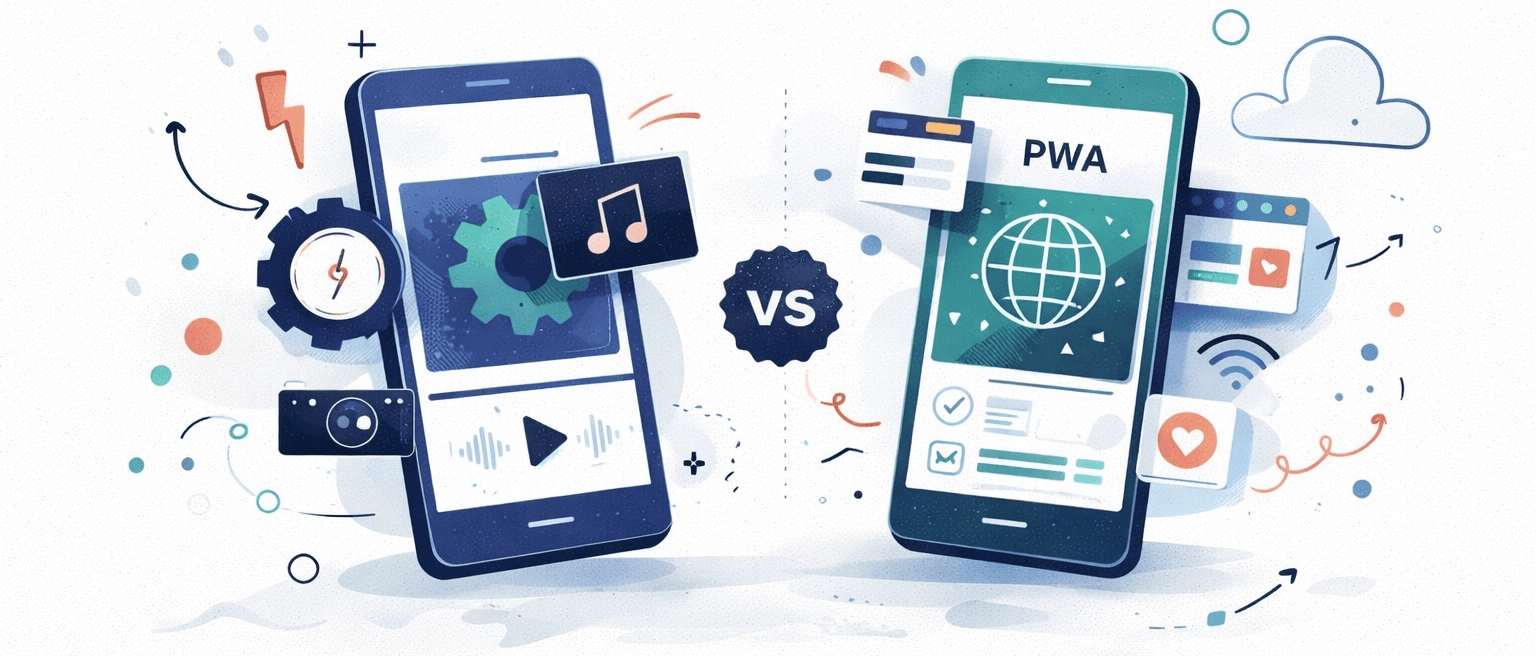
Introduction
You have a mobile app project and your developer asks: "Do you want native or a PWA?" If you're not technical, that question can seem abstract. Yet your answer will determine your budget, timeline, and the final experience of your users.
What is a native app?
A native app is developed specifically for one OS — iOS (Swift/SwiftUI) or Android (Kotlin/Jetpack Compose). It's distributed via the App Store or Google Play and installs directly on the device.
Advantages: maximum performance, full hardware access (camera, GPS, biometrics, push notifications), optimal UX, and store visibility.
Disadvantages: two codebases if targeting both platforms, higher cost, store review process, and user-dependent updates.
What is a PWA?
A Progressive Web App is an enhanced website that behaves like a mobile app. It runs in the browser, can be installed on the home screen, and works offline via Service Workers.
Advantages: one codebase for all platforms, 40–60% lower cost than native, no store review, instant server-side updates, Google-indexable (SEO).
Disadvantages: limited hardware access on iOS, no App Store presence, slightly lower performance for complex animations.
"The best technology isn't the newest one — it's the one that precisely meets your business need." — our technical team
The comparison in numbers
Native iOS + Android: average budget $30,000–$90,000, delivery 4–8 months for a full V1.
PWA: average budget $10,000–$30,000, delivery 6–12 weeks. These figures vary with complexity, but the gap is significant.
When to choose what?
Choose native if: your app needs high graphical performance (games, AR/VR), deep hardware access (Bluetooth, NFC), in-app purchases, or your audience is primarily on iOS.
Choose a PWA if: you're launching an MVP to validate your idea fast, your app is informational or transactional (e-commerce, SaaS), your budget is limited, or SEO is a priority.
The hybrid approach: the best of both worlds?
Frameworks like React Native or Flutter allow you to develop an app with a single codebase that compiles natively on iOS and Android — near-native performance with budgets reduced by ~40%. Airbnb, Facebook, and Instagram have all used React Native. Flutter, built by Google, is rapidly gaining ground.
Our recommendation
For a first product, start with a PWA or hybrid app to validate your idea at lower cost, then invest in pure native if the KPIs justify it. We help you choose the right technology based on your business goals — not on what's trending.
Continue Reading
Read Also

Why Your Business Absolutely Needs a Professional Website in 2026
A website isn’t a luxury—it’s your 24/7 global storefront. Invest in a professional site and make your business more profitable in 2025.

UI/UX Design: How Great Design Can Double Your Conversion Rate
Bad design drives customers away. Great design converts. Discover key UI/UX principles to turn visitors into buyers—and how to apply them.